

By Florence Joshua- Lantern News
A job offer. A scholarship. A promise of a better life abroad.
For thousands of people around the world, these opportunities appear genuine. But behind many of them lies a carefully planned trap that ends in exploitation, forced labour, sexual abuse, or criminal activity.
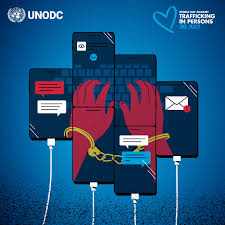
As Nigeria joins the rest of the world to commemorate the 2026 World Day Against Trafficking in Persons on July 30, the United Nations Office on Drugs and Crime (UNODC) is warning that human trafficking is taking a dangerous new turn—one driven by technology and online scams.
This year’s global campaign, themed “Trapped Behind the Scam,” shines a spotlight on victims who are recruited through fake online job advertisements and fraudulent employment opportunities before being trafficked into exploitative situations.
Speaking at the launch of activities marking the World Day Against Trafficking in Persons at the National Agency for the Prohibition of Trafficking in Persons (NAPTIP) headquarters in Abuja, the UNODC Country Representative, Mr. Cheikh Toure, said many people involved in online scam operations are themselves victims of trafficking.
“Behind many online scam operations lie people who are themselves victims of trafficking, lured through deceptive job advertisements, false promises of employment, or fraudulent opportunities abroad, only to find themselves ensnared in coercion, abuse, intimidation, and exploitation.”»
His remarks reflect a growing global concern that organised criminal networks are increasingly using digital platforms to recruit victims across borders.
The Digital Face of Human Trafficking
Gone are the days when traffickers relied solely on physical recruiters operating in villages and urban communities.
Today, they hide behind social media accounts, messaging applications, fake recruitment agencies, and fraudulent websites.
Young graduates searching for employment, professionals seeking better opportunities, and desperate job seekers are becoming easy targets.
According to UNODC, what begins as an attractive employment offer can quickly become forced labour, cybercrime, sexual exploitation, or other forms of modern slavery.
The organisation warns that technology has become one of the most powerful tools in the hands of traffickers, making awareness and digital vigilance more important than ever.
Why young Nigerians are vulnerable
Nigeria’s youthful population remains one of its greatest strengths, but also one of its greatest vulnerabilities.
Mr. Toure noted that trafficking thrives where genuine opportunities are limited.
“When young people cannot find decent work at home, they become the very population traffickers seek out with false promises abroad,” he said.
For many Nigerian youths facing unemployment and economic hardship, migration often appears to be the only path to success. Criminal networks understand this desperation and exploit it.
UNODC argues that tackling trafficking therefore requires more than arrests and prosecutions.
It requires investments in education, vocational training, entrepreneurship, and job creation.
Every young person equipped with employable skills, the agency says, represents one less potential victim for traffickers.
More than a crime
Human trafficking is widely recognised as one of the world’s fastest-growing organised crimes.
It affects women, men, and children regardless of nationality or background.
Victims may be forced into domestic servitude, sexual exploitation, forced labour, begging, organ trafficking, forced marriages, or criminal activities.
Beyond the physical abuse, trafficking strips victims of their dignity, freedom, and basic human rights while generating billions of dollars annually for criminal organisations.
Four priorities for action
UNODC says ending trafficking requires a comprehensive response built on four key pillars.
The first is prevention through sustained public awareness, especially about deceptive online recruitment and migration scams.
The second is victim protection, ensuring that people forced into criminal activities are recognised as victims rather than offenders and receive appropriate support.
The third is strong investigations and accountability to dismantle trafficking networks and prosecute perpetrators.
Finally, the organisation emphasises the importance of partnerships involving government agencies, law enforcement, civil society, technology companies, community leaders, international organisations, and the media.
The role of the media
The media also carries significant responsibility.
Mr. Toure urged journalists to report responsibly by protecting survivors’ identities while exposing trafficking networks and fraudulent recruitment schemes.
Accurate reporting, he noted, can increase public awareness, encourage early reporting, and help prevent others from falling victim.
Nigeria’s continuing fight
UNODC reaffirmed its commitment to supporting Nigeria in strengthening criminal justice responses, improving victim protection, and preventing trafficking through partnerships with NAPTIP and other stakeholders.
Activities lined up for this year’s commemoration include awareness campaigns, an awareness walk, a novelty football match, and the main World Day Against Trafficking in Persons event on July 30.
A shared responsibility
The message from this year’s campaign is simple but urgent: behind every online scam may be a human being who has been deceived, exploited, and stripped of freedom.
As technology evolves, traffickers continue to adapt their methods. Governments, communities, families, and individuals must do the same.
Stopping human trafficking begins with recognising the warning signs, questioning offers that appear too good to be true, and ensuring that young people have genuine opportunities at home.
Because every legitimate job created, every young person empowered, and every victim protected weakens the business model of traffickers.
On this World Day Against Trafficking in Persons, the call is not only to expose the scam but to see the victim trapped behind it.







Leave a Reply