

Amid a suspected insurgent plot targeting the airport and correctional facilities in Abuja and neighbouring Niger State, security agencies have moved to reinforce the sites.
The Nigeria Police Force, the Nigeria Immigration Service, and the Nigeria Correctional Service had on Thursday said they have proactively strengthened security around the airports and custodial centres.
The Washington Post had reported an internal memo from the Nigerian Customs Service, which disclosed plans by terrorists to attack the Nnamdi Azikiwe International Airport and Kuje Custodial Centre in the Federal Capital Territory and the prison facility in Niger State.
It said the attacks are being planned by fighters of the Islamic State West Africa Province, Boko Haram, Ansaru and Jama’at Nusrat al-Islam wal- Muslimeen.
The memo dated 13 April, 2026 and signed by Timi Bomodi, a Deputy Comptroller General in charge of the Enforcement, Inspection and Investigation unit, stated that the terrorists are also targeting a military detention facility in Wawa, Niger State.
The two-page document claimed the ISWAP fighters have already infiltrated the FCT in preparation for the attack on the airport and Kuje prison in a move to release detained insurgents.
The document noted that the planned airport attack bore similarities to Islamic State strikes on aviation facilities in Niamey and Tahoua in the Niger Republic, suggesting a possible intent to replicate the pattern inside Nigeria.
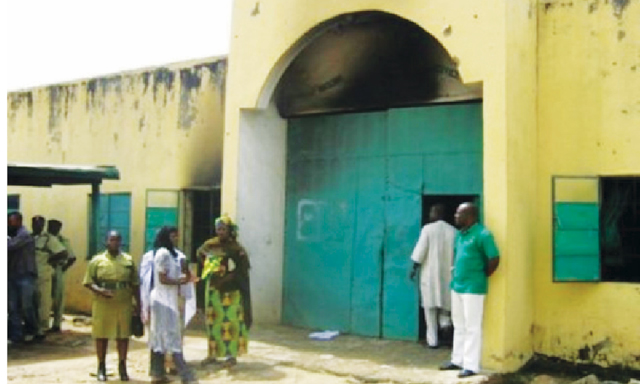
In July 2022, a coordinated attack on the Kuje Correctional Centre by various terrorist groups led to the release of 64 detainees.
Three months later, in October 2022, terrorists attempted to breach the Wawa Cantonment in Borgu LGA of Niger State in a bid to free detained insurgents, though the assault was repelled and several attackers killed or arrested.
The Sadiku Boko Haram faction, which operates alongside Ansaru and JNIM in the vicinity of Kainji Lake National Park, moved from Shiroro LGA in Niger State to the Kainji axis in July 2025, where it kidnapped more than 300 students and staff at St. Mary’s Catholic school in Papiri.
The group has also been linked to the abduction of more than 100 women and children from Woro in Kwara State, and Kasuwan Daji and Konkoso in Niger State.
The Customs Service, in response to the memo, directed its operatives to strengthen surveillance around the airport and other strategic assets, ordered thorough screening of all visitors to its facilities and deployed specialised anti-smuggling and intelligence units to reinforce security across identified vulnerable points.
Speaking on counter- measures, the spokesperson for the Airport Police Command, Adeola Muhammed, said the agency remains fully alert and in control of security operations.
He assured that security architecture at the airport is designed to stay ahead of evolving threats, noting that multiple layers of checks at the aerodrome are capable of detecting any suspicious activity.
According to him, intelligence gathering and inter-agency collaboration have continued to strengthen the command’s response capacity.
“The command is always aware of potential security threats, and we are prepared to scale up measures as the situation demands. Whether you are entering or exiting the airport, you will be thoroughly screened,” he noted.
Muhammed added that strong synergy among security agencies, particularly in intelligence sharing, has been key to the safety at the airport.
“There is effective collaboration between all security agencies when it comes to intelligence sharing, and as a result, the command is, and will always remain a step ahead of any threat,” he stated.
The Immigration Service, on its part, revealed it had heightened security measures at all its facilities across the FCT following the intelligence report on the plot.
The NIS spokesperson, Akinsola Akinlabi, stressed that the service was taking no chances, even as he expressed confidence that the police and army were already responding to the threat.
Speaking to our correspondent in Abuja on Thursday, Akinlabi said, “We are sure the police are handling this threat already, and a section of the army too.’’
The spokesperson added that the Correctional Service was also responding to the issue, saying, “The one that has to do with Corrections, they are taking close measures at their facilities.”
The Nigerian Correctional Service assured Nigerians of heightened security measures across its facilities, urging Nigerians to remain calm and continue their daily activities without fear.
The Service spokesperson, Jane Osuji, said the authorities had placed the custodial centres on high alert nationwide, particularly in the FCT.
“We want to assure Nigerians that our facilities in Abuja and other states are on high alert. We have taken proactive steps. We also want to assure Nigerians not to panic; they should go about their lawful activities without fear or apprehension,” she said.
Addressing the development, a security analyst, Chidi Omeje, called on the government to take intelligence reports more seriously, warning that past failures to act decisively had led to avoidable attacks.
“The very clear thing the government should do is to take it seriously, to take intelligence reports seriously. We’ve had such experiences before where warnings were detailed, yet the predictions came to pass,” Omeje said.
He noted that the current security climate across the country remained fragile, stressing that credible intelligence from government agencies must be matched with proactive counter-intelligence measures and improved public communication.
“There is heightened insecurity across the country. If such intelligence comes from credible sources, authorities must take precautionary steps—monitor the situation closely, place security forces on alert, and properly inform citizens on what to do,” he added.
Omeje further warned that states surrounding the FCT, including Niger and Kogi, remain vulnerable, making Abuja susceptible to infiltration by armed groups.
“These contiguous states are already facing serious security challenges, and attackers can easily slip in to wreak havoc. Critical infrastructure such as airports and correctional facilities are natural targets,” he said.
Another security expert, Lekan Jackson-Ojo, criticised what he described as a pattern of poor response to intelligence warnings, citing previous incidents where security deployments were either inadequate or prematurely withdrawn.
“Over time, we have seen cases where intelligence reports were received, but the response was ineffective. In some instances, security personnel were deployed briefly and withdrawn before any attack occurred, leaving communities exposed,” Jackson-Ojo said.
He also raised concerns about the politicisation of security issues, arguing that it has undermined effective response and accountability.
“The problem is that security has been politicised. Statements have been made about alleged sponsors of insecurity, yet no concrete action has followed. This weakens public confidence and emboldens attackers,” he said.
Jackson-Ojo advised the authorities not to concentrate security resources solely in Abuja at the expense of other vulnerable places.
“They must beef up security in the FCT, but not at the detriment of other states like Niger, Sokoto, and Zamfara. If all attention is shifted to Abuja, it creates loopholes elsewhere, which these groups can exploit,” he added.
The Punch





Leave a Reply