

By Florence Joshua
Nigeria has moved to confront the growing threat of digital misinformation and AI-powered disinformation with the launch of a nationwide fact-checking coalition, as diplomats, security experts, media professionals and policymakers warned that information warfare poses a direct threat to democracy, national security, and economic stability.
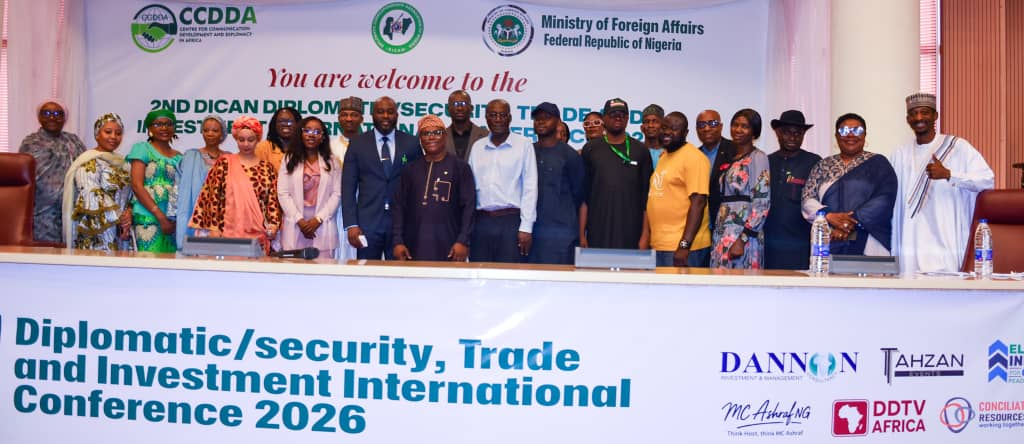
The warning came during the 2nd Diplomatic, Security, Trade and Investment International Conference organised by the Diplomatic Correspondents Association of Nigeria (DICAN) at the Ministry of Foreign Affairs in Abuja.
The conference, with the theme: “Information Warfare: Strengthening Global Security, Trade and Investment Through Collaborative Truth; The Role of Diplomacy, Intelligence and Media,” brought together key stakeholders from government, diplomatic community, intelligence services, civil society and the media to address the escalating dangers of fake news, deepfakes, propaganda and AI-generated manipulation.
According to the stakeholders, the global economy is losing an estimated $100 billion annually due to the growing impact of disinformation campaigns, declining investor confidence, reputational damage and digitally fueled instability.
Representing former President Goodluck Jonathan, the Executive Director of the Goodluck Jonathan Foundation, Ann Iyonu, described misinformation as one of the greatest threats confronting modern democracies.
“Today, the world faces a new kind of conflict; one fought not only with weapons, but with information,” she said.
She warned that fake news, manipulated content and deliberate disinformation campaigns have become dangerous tools capable of dividing societies and destabilising nations.
“False narratives, fake news, manipulated content and deliberate disinformation campaigns have become powerful tools capable of creating division, undermining public trust and destabilizing societies,” she stated.
Iyonu further said that Nigeria has repeatedly experienced the damaging consequences of unverified information, particularly during periods of insecurity and political tension.
“In Nigeria, we have seen how fake news and unverified information can inflame tensions, deepen ethnic and religious divisions, fuel insecurity and weaken confidence in public institutions,” she said.
She stressed that strengthening information integrity had become essential to democratic survival, particularly ahead of elections.
“Credible elections depend not only on transparent electoral systems, but also on access to factual information.”
Diplomatic journalism as a bridge builder
The Permanent Secretary of the Ministry of Foreign Affairs, Dunoma Umar Ahmed, commended DICAN for convening the conference and highlighted the strategic importance of diplomatic journalism.
“The media remains a critical partner in promoting constructive dialogue, mutual understanding, and informed discourse among nations,” Ahmed said.
According to him, diplomatic journalism serves as a bridge between governments and citizens while promoting accountability and international cooperation.
“Diplomatic journalism serves not only as a vital bridge between governments and citizens, but also as a powerful catalyst for transparency, accountability, and international cooperation,” he stated.
During the event, the Permanent Secretary officially launched the Nigeria Fact-Check and Information Integrity Network (NFIIN), a nationwide coalition aimed at combating misinformation and improving information verification systems across the country.
Ahmed explained that the campaign would focus on three major messages:
“Verify Before You Share,”
“Truth Matters: Build a Stronger, Safer Society,” and
“Think Before You Share.”
He noted that the initiative had been translated into English, Hausa, Yoruba and Igbo to ensure nationwide accessibility and impact.
Threats of AI generated disinformation as ‘Industrialised Deception’
DICAN Chairman, Idehai Frederick, warned that the world had entered an era of “industrialised deception,” where state and non-state actors now weaponise information using sophisticated technologies.
According to figures presented during the conference, over 70 per cent of Foreign Information Manipulation and Interference (FIMI) campaigns now rely on generative artificial intelligence capable of creating convincing deepfakes, fabricated public statements and manipulated media content.
Frederick described the development as “competitive sovereignty theft,” warning that coordinated online propaganda campaigns now have the capacity to influence elections, distort financial markets and escalate diplomatic tensions within minutes.
The economic implications of disinformation also featured prominently during the conference.
The Executive Director and Chief Executive Officer of the Nigerian Export Promotion Council, Nonye Ayeni, warned that false information could undermine trade growth and investor confidence.
$6bn worth of non-oil export in 2025
Ayeni revealed that Nigeria recorded over $6.1 billion in non-oil exports in 2025, representing an 11.5 per cent increase from the previous year.
“Information integrity is now an economic issue,” she said. “Without credible information systems, trade partnerships weaken and investment confidence declines.”
International partners also participated in the discussions.
Zhou Hongyou praised Nigerian journalists for promoting stronger China-Nigeria relations through balanced reporting and called for deeper collaboration in tackling misinformation and improving digital reporting standards.
Organisers disclosed that the newly launched coalition has already mobilised 69 civil society organisations across Nigeria’s 36 states, with six regional situation rooms established to monitor and rapidly respond to false information circulating online.







Leave a Reply